
Numerical analysis of river waves hydro-dynamics
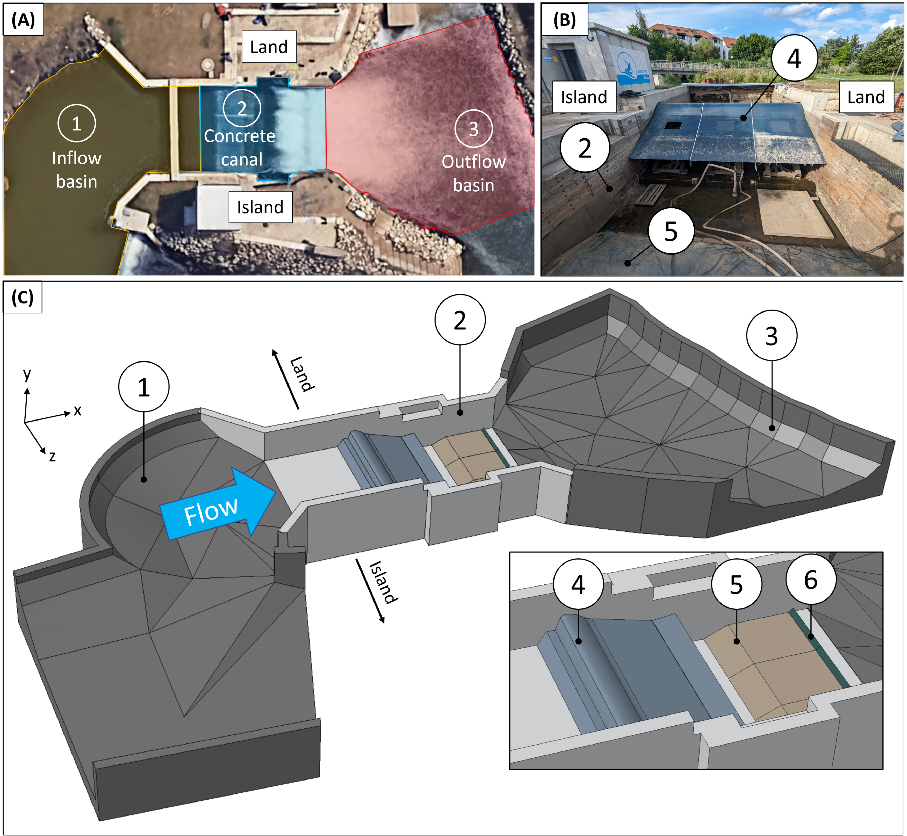
Our research also addresses the hydrodynamic optimization and safety of artificial standing waves themselves. River surfing environments, particularly engineered systems such as the Fuchslochwelle, present challenges related to flow dynamics, including the formation of recirculation zones that can pose safety risks at higher inflow rates. To mitigate these issues, we performed computational fluid dynamics simulations using STAR-CCM+ to investigate geometric modifications (Schwalbe et al. 2025). A three-dimensional CAD model was developed to analyze multiple configurations of baffles and inlays, with a focus on reducing vorticity and improving flow stability. The results demonstrated that specific baffle placements significantly reduced recirculation zones by more than 50%. Moreover, both symmetrical and asymmetrical configurations proved effective in enhancing flow conditions. The practical implementation of these findings led to an increase in safe operational inflow from 7.5 m³/s to 9 m³/s, representing a 20% improvement and enabling safer use for surfers of varying skill levels.
Contact Persons


Papers
J. Schwalbe, B. Tur, S. Kniesburges, N. Neuss, M. Stingl, T. Keck, J. Buff, M. Döllinger. Modeling and Simulation of Standing Wave Configurations for Outflow Improvement and Minimizing Undesired Recirculation. Appl Sci, vol. 15(6), pp. 3127, https://doi.org/10.3390/app15063127, 2025